
A crane operator depends on accurate boom information every time a load is lifted, moved, or positioned. Boom angle is an important part of this information.
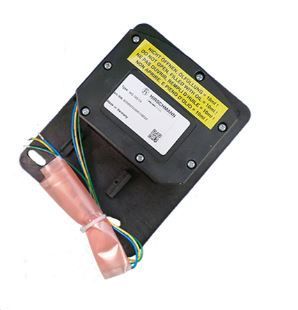
The WIKA Hirschmann WG143 Angle Sensor measures the angle of the main boom and sends that information to the crane monitoring system. Understanding how it works also shows why proper installation and signal transmission matter.
What Does the WIKA Hirschmann WG143 Angle Sensor Do?
The main job of the angle sensor is to measure the boom angle.
Inside the sensor, a weighted pendulum responds to changes in the boom position. It drives a potentiometer, allowing the system to detect the boom's angle.
The sensor provides:
- Accurate boom angle information
- Continuous measurement as the boom moves
- Input for crane monitoring systems
- Signal transmission through the CAN bus system on compatible versions
For the WG143/9 version, the stated accuracy is less than 0.2°, with an ambient temperature range of -40°C to +70°C.
How Does the Sensor Measure Boom Angle?
The WG143 uses a weighted pendulum to detect changes in boom position. Oil damping helps control pendulum movement and supports a more stable measurement.
The process is straightforward:
- The crane boom changes position.
- The pendulum responds to the movement.
- The pendulum drives the angle potentiometer.
- The sensor produces an electrical output.
- The signal moves to the crane monitoring system.
For the WG143/9, the output options include 4 to 20 mA and CANopen, depending on the system configuration.
Where Is the Angle Sensor Located?
In the WG143/9 setup, the angle sensor is contained within the cable reel on the left side of the main boom. The angle sensor and CAN bus converter board are located together inside the cable reel.
The signal path can be understood as:
Angle sensor → CAN bus converter board → CAN bus → pressure transducer/T-connector → main CAN bus → central unit
The sensor therefore works as part of the crane's larger monitoring network.
Why Does Accurate Boom Angle Matter?
As the boom moves, its position and working conditions change. The monitoring system needs reliable angle information to keep track of these changes.
Accurate angle data can help:
- Monitor changing boom positions
- Support load and operating calculations
- Provide information to the central monitoring unit
- Give operators clearer information about crane conditions
The sensor is one part of the overall safety system, so correct installation, calibration, and maintenance remain important.
WG143/4 Uses a Different Setup
The WG143/4 is another configuration used with specific LWG assemblies.
It has an angle range of 0° to +90°, accuracy of less than 0.2°, and an ambient temperature range of -40°C to +70°C.
The LWG assembly combines length and angle measurement in one housing at the boom base. The angle section uses an oil-filled box with a pendulum that drives the angle potentiometer.
Its specified output is -1.875 V to -3.125 V, with a power supply voltage of -5.00 V.
Knowing the exact sensor version matters because its output, mounting arrangement, and system connection can differ.
What Should Technicians Pay Attention To?
A sensor can only provide useful information when the complete measurement path is working properly.
During inspection or maintenance, check:
- Physical damage around the sensor or cable reel
- Loose or damaged wiring
- Electrical connections
- Unusual signal readings
- Proper mounting and alignment
- Condition of related cable reel components
- Compatibility with the crane monitoring system
If the boom-angle reading seems incorrect, the sensor may not be the only possible cause. Wiring, connectors, the converter board, mounting, and other parts of the signal path can also affect the reading.
Conclusion:
The WIKA Hirschmann WG143 Angle Sensor is an important link in the crane monitoring system. By measuring boom angle and sending that information to the system, it helps track changing boom positions.
For systems using related components, the WIKA Hirschmann LG105 Cable Reel Assembly can also form part of the measurement and signal path.